


Shared Coasts, Divided Historiographies
Mobilizing People, Ideas, and Artifacts in the East Asian Mediterranean
この地図は富山県が作成した地図を転載・加工したものです。
This map is credited by Toyama Prefecture, Japan.
Lectures
The Furniture and Objects Depicted in Ryukyu Royal Portraits
「御後絵」に描かれた家具および道具類について
HIRAKAWA Nobuyuki平川信幸
沖縄県立博物館・美術館 主任学芸員
Abstract
琉球王国王の肖像画「御後絵」は、単なる肖像画ではなく、儀礼空間を象徴化し王の権威を視覚化した絵画作品である。中央に国王を配し、背景に宮廷の設えや儀礼具、家臣団を描いた構成は、中国・韓国・日本の帝王像と一線を画す。沖縄戦で失われたものの、鎌倉芳太郎撮影の写真と近年返還された作品により、その文化的価値が再び注目されている。
本報告では背景に描かれた衝立や香炉などの、重要な図像の変遷から、王権表象の変化を読み解いていく。
本研究はJSPS科研費JP24K15942の助成を受けたものです。
October 21, 2025

International Symposium
Decentering the East Asian Mediterranean
Moving Artists, Artefacts, and Concepts
Venue: Conference Room, 2F. College of Liberal Arts, National Taiwan University
June 30-July 1, 2025

The Continental Roots of Arita Porcelain
Dr. Andrew L. Maske
Professor of Museum Studies, Wayne State University, U.S.A.
Abstract
Although Japan was a latecomer to the production of porcelain among East Asian countries, its quality and innovative decoration eventually exerted a tremendous impact on the development and appreciation of porcelain around the world. The earliest porcelain known in Japan was imported from China, but the first craftsmen to make it there were of Korean origin, not Chinese. This presentation will examine the details of how porcelain technology came to Japan, and how stylistic precedents on the continent combined with native cultural requirements to influence not only the early development of Japanese porcelain, but continuing imports of Chinese porcelain as well.
June 17, 2025

Korea-Japan-Ryukyu in the Edo Period from the Perspective of Watanabe Zen'emon
KIDO Hironari 木土博成
Associate Professor, Kyushu University.
Abstract
During the Edo period, an envoy from Korea, a foreign country, came to Japan to celebrate the replacement of the shogun. Similar envoys also came to Japan from Ryukyu, a foreign country that was subordinate to the Satsuma clan. There were Japanese who made detailed observations of these Korean and Ryukyuan envoys and recorded them in records and illustrations. This seminar will focus on Watanabe Zen’emon (1701–1761), a samurai of the Yodo clan (present-day Kyoto City), who possessed an excellent eye for observation. Together with experts in various fields, we would like to take a close look at his writings and drawings. By approaching the viewpoint of a person who lived in the Edo period, we will be able to see some aspects of the relationship between Japan and Korea and Ryukyu in the 18th century.
January 29, 2025 15:00

Huang Tu-shui (1895–1930) and His Era: The Beginnings of “Taiwanese Art” Under Imperial Japanese Rule
SUZUKI Eka 鈴木恵可
Assistant Research Fellow Institute of History and Philology, Academia Sinica.
Abstract
(insert)
January 9, 2025 17:00

Visualizing “Homeland”: The Development of Taiwanese Art during the Japanese Colonial Period
CHIU Hanni
Associate Professor, Graduate Institute of Art History, National Taiwan University.
Abstract
(insert)
December 2, 2024 17:00

East Asia’s Changing Landscapes: The view from Korea’s Diamond Mountains
Tessa Morris-Suzuki
Australian National University, College of Asia and the Pacific
Abstract
In 2018, the year when North and South Korean leaders met at the 38th parallel and US President Donald Trump met Kim Jong-Un in Singapore, New York’s Metropolitan Museum of Art held a major exhibition focused on Mt. Kŭmgang: the Diamond Mountains – a mountain range which possesses profound historical and cultural importance to Koreans on both sides of the political divide. Mt. Kŭmgang has been viewed and imagined in multiple ways from diverse cultural perspectives: as a sacred mountain, a site of Buddhist pilgrimage, and a source of inspiration to Korean artists and literati; as a focus of travel and tourism in the Japanese empire; as a subject for European and American orientalist art; as a symbol of the Korean struggle for liberation from colonial rule; as a nationalist icon for both North and South Korea, and as a place where North and South have fleetingly come together. In this paper, I take the Diamond Mountains as a vantage point from which to consider the shifting nature of cultural and political relations in the East Asian region. How can this vantage point help us to reconsider the nature of East Asia as a region, and what visions of East Asia’s future can be imagined from Mt. Kŭmgang?
September 26, 2024 4:00pm

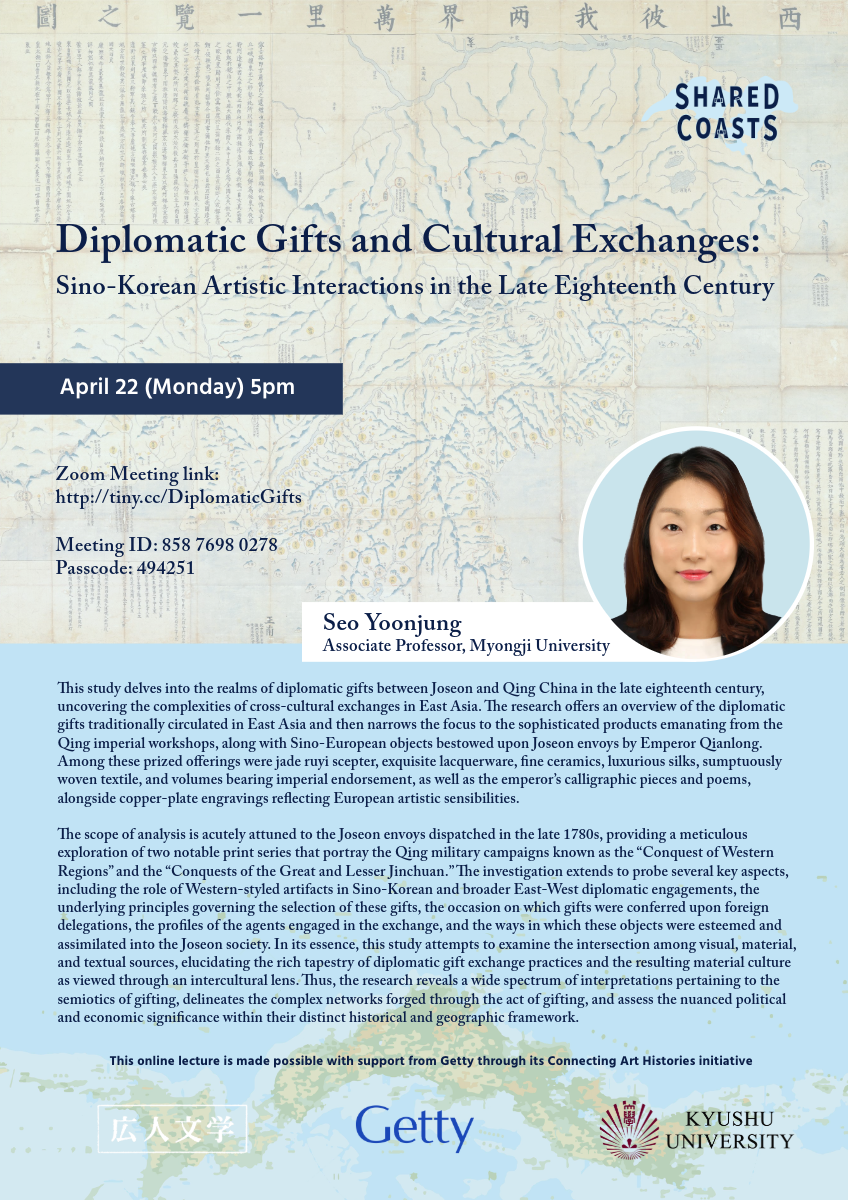
Diplomatic Gifts and Cultural Exchanges: Sino-Korean Artistic Interactions in the Late Eighteenth Century
Seo Yoonjung
Associate Professor, Myongji University
Abstract
This study delves into the realms of diplomatic gifts between Joseon and Qing China in the late eighteenth century, uncovering the complexities of cross-cultural exchanges in East Asia. The research offers an overview of the diplomatic gifts traditionally circulated in East Asia and then narrows its focus to the sophisticated products emanating from the Qing imperial workshops, along with Sino-European objects bestowed upon Joseon envoys by Emperor Qianlong. Among these prized offerings were jade ruyi scepter, exquisite lacquerware, fine ceramics, luxurious silks, sumptuously woven textile, and volumes bearing imperial endorsement, as well as the emperor’s calligraphic pieces and poems, alongside copper-plate engravings reflecting European artistic sensibilities.
The scope of analysis is acutely attuned to the Joseon envoys dispatched in the late 1780s, providing a meticulous exploration of two notable print series that portray the Qing military campaigns known as the “Conquest of Western Regions” and the “Conquests of the Great and Lesser Jinchuan.” The investigation extends to probe several key aspects, including the role of Western-styled artifacts in Sino-Korean and broader East-West diplomatic engagements, the underlying principles governing the selection of these gifts, the occasion on which gifts were conferred upon foreign delegations, the profiles of the agents engaged in the exchange, and the ways in which these objects were esteemed and assimilated into the Joseon society. In its essence, this study attempts to examine the intersection among visual, material, and textual sources, elucidating the rich tapestry of diplomatic gift exchange practices and the resulting material culture as viewed through an intercultural lens. Thus, the research reveals a wide spectrum of interpretations pertaining to the semiotics of gifting, delineates the complex networks forged through the act of gifting, and assesses the nuanced political and economic significance within their distinct historical and geographic framework.
April 22, 2024 5:00pm
Angkor Wat as Gion Shōja: Japanese Mappings of Buddhist India in Maritime East Asia
D. Max Moerman
Professor, Barnard College/Columbia University
Abstract
In premodern Japan, Buddhist India was not confined to the South Asian subcontinent of contemporary geography. It represented a holy land of sacred origins rendered through the narratives of Chinese Buddhist pilgrims. With the arrival of Iberian traders and Jesuit missionaries and the expansion of maritime trade, however, this classical image of Buddhist India was radically transformed and transposed onto Southeast Asian landscapes. This talk examines sixteenth-century Jesuit letters, seventeenth-century maps of Jētavana, and eighteenth-century narratives which extended from popular encyclopedias to the print culture of the Kabuki stage to trace the shifting and capacious cartography of Buddhist India in the Japanese geographic imagination.
November 6, 2023

Opening Event - October 26, 2023
Kyushu University, Ito Guesthouse, Conference Hall
